Best Blue Light Glasses for Beginners: Buyer Guide
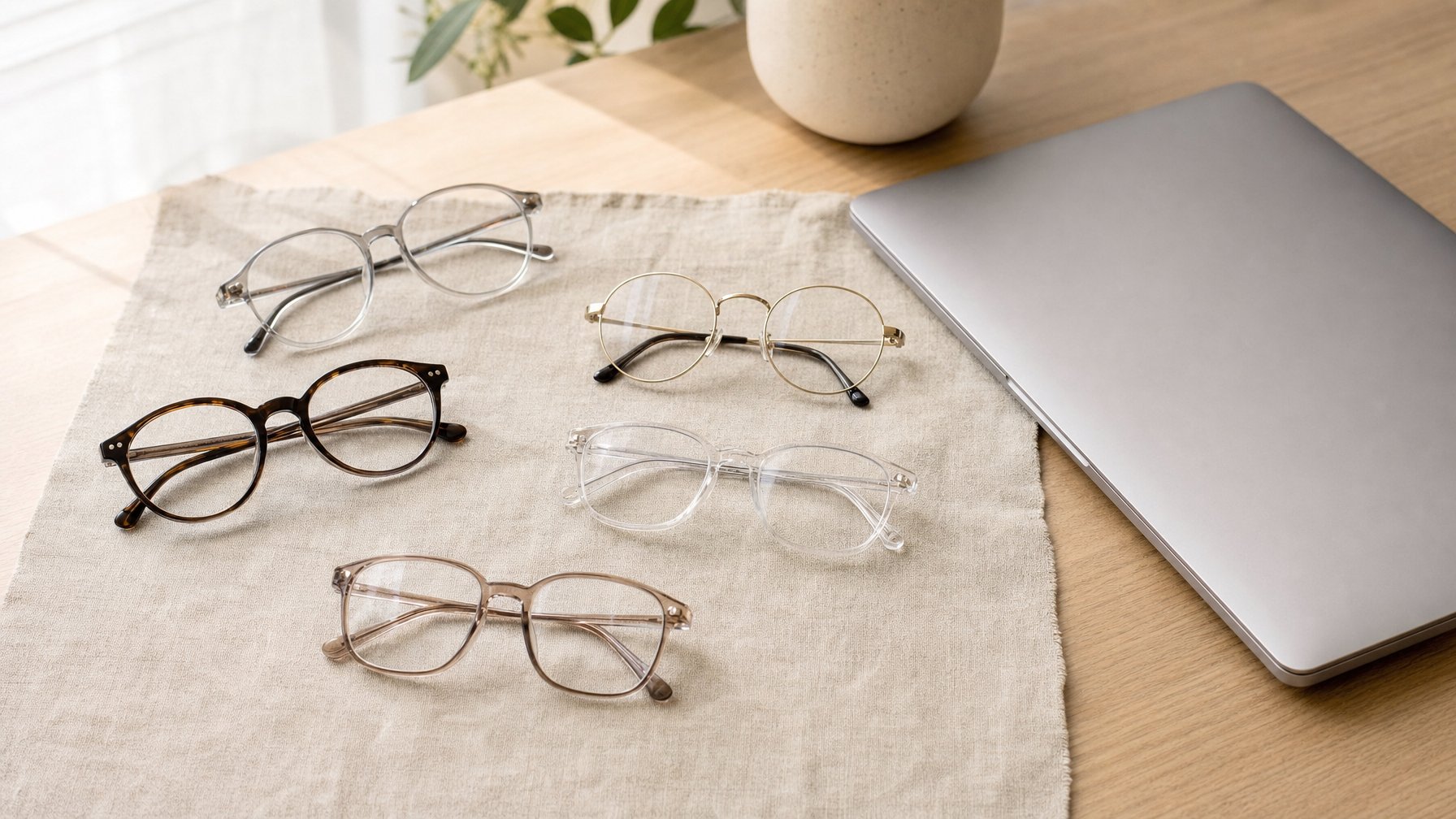
Most first-time buyers reach for blue light glasses after a long stretch at computer screens, and the honest expectation to set is modest: a filtered lens changes how a screen feels, but it does not replace the habits that cause digital eye strain in the first place. Long hours, low blink rates, dry office air, and glare all contribute, and none of those are fixed by tinting a lens.
That said, a comfortable first pair is inexpensive, low-risk, and easy to test. Clear-lens filters run under $30 in many cases, and CNET’s testing team named a sub-$30 pair with optional magnification as its best budget blue light-blocking pick. A beginner’s best move is to match the lens tint to the time of day: clear or very lightly tinted lenses for daytime work on laptops and monitors, and amber or orange lenses only for evening screen use.
The evidence picture matters here too. A Cochrane systematic review found no reliable short-term benefit for blue-filtering lenses on visual fatigue, which is why lens tint, frame comfort, and return policies deserve more scrutiny than a marketing percentage on the box.
Key Takeaways
- Clear lenses suit daytime screen work; amber or orange tints belong to evening and late-night sessions.
- Research supports evening light management for sleep more strongly than eye-strain relief.
- Coatings, fit measurements, and a real return window are worth more than a blue light test card.
Choose a Starting Pair by Your Main Use
The most useful sorting question for a first pair is when the glasses will be worn, since a clear lens preserves color accuracy for daytime spreadsheets and design work while an amber-tinted lens is built for the hours before bed. Vision correction adds a third path, either as a filtering coating on prescription lenses or as a dedicated pair of computer glasses.
For Daytime Work and Study: Start With Clear Lenses
Clear lenses are the safe default for work-from-home days, classes, and long screen sessions where color has to look right. Reflection-based coatings sit in ultra-thin layers and appear nearly invisible, which is why they dominate professional eyewear, according to a beginner’s overview of lens filtering methods.
Blocking percentages in this category tend to sit in the 20% to 50% range. That is fine for daytime screen use. A heavier filter during working hours shifts on-screen color enough to be distracting, especially for photo editing or anything involving brand colors.
For Late-Night Gaming and Evening Scrolling: When Amber or Orange Lenses Make Sense
Amber-tinted, orange, and red-tinted lenses absorb a much larger share of the blue light spectrum, sometimes above 90%, and that is the category with the most plausible mechanism behind it. Evening light suppresses melatonin production, so a deeper tint after sunset targets a real biological pathway.
The tradeoff is color. Amber lenses make whites look warm and skin tones look off, which is why they suit late-night gaming, TV, and phone scrolling more comfortably than color-critical work.
Beginners who try amber during the day often abandon the glasses entirely because the tint feels wrong. Keeping the tint scheduled to evening avoids that.
For Vision Correction: Prescription Lenses, Fit-Overs, and Computer Glasses
Anyone already wearing prescription glasses should ask an optometrist to add a blue light filtering option to the next pair, since most filtering treatments can be applied to a standard prescription. That avoids stacking two frames and keeps the optical center correct.
Fit-over frames that slide across existing glasses exist and cost little, though they sit heavy on the nose and look bulky. Computer glasses are a separate idea worth knowing: they carry a mild plus power tuned to an arm’s-length monitor distance, and that focusing help is often what people credit to the tint. A clinician can confirm whether a small intermediate correction is the actual fix.
Beginner-Friendly Product Types and Brands to Compare
Four product types cover almost every beginner scenario. The comparison below reflects the criteria that change the buying decision.
- Budget non-Rx (e.g. Benicci blue light glasses): Typical price tier — Prescription with filter (e.g. Warby Parker): Under $30 — Amber evening pair: $95+ with lens add-on — Gaming-specific: $30 to $90 — Col 5: $50 to $100
- Budget non-Rx (e.g. Benicci blue light glasses): Lens tint — Prescription with filter (e.g. Warby Parker): Clear to faint yellow — Amber evening pair: Clear — Gaming-specific: Amber or orange — Col 5: Light amber
- Budget non-Rx (e.g. Benicci blue light glasses): Color accuracy — Prescription with filter (e.g. Warby Parker): Good — Amber evening pair: Good — Gaming-specific: Poor — Col 5: Fair
- Budget non-Rx (e.g. Benicci blue light glasses): Best time of day — Prescription with filter (e.g. Warby Parker): Daytime — Amber evening pair: Daytime — Gaming-specific: Evening only — Col 5: Evening
- Budget non-Rx (e.g. Benicci blue light glasses): Return window matters — Prescription with filter (e.g. Warby Parker): Yes — Amber evening pair: Yes, plus Rx accuracy — Gaming-specific: Yes — Col 5: Yes
Buying one inexpensive clear pair and one amber pair costs less than a single premium frame and answers the tint question faster than reading spec sheets.
What Blue Light Filters Can and Cannot Do
Blue light filtering has weak evidence for relieving eye strain and stronger, though still developing, evidence for evening light management and sleep. Separating those two claims prevents most buyer disappointment.
Do Blue Light Glasses Reduce Eye Strain or Headaches?
Controlled trials have not shown that blue-filtering lenses meaningfully reduce eye fatigue, headaches, or dry eyes compared with standard clear lenses. A Cochrane review of randomized trials reached that conclusion for short-term visual fatigue outcomes, and the American Academy of Ophthalmology has taken the position that screen-related discomfort comes from how screens are used, not from blue light wavelengths themselves.
There is also no credible evidence that screen blue light exposure causes eye damage. Screens emit a small fraction of the blue light in daylight.
Migraine sufferers are a partial exception. Some people with light sensitivity report relief from specific tinted lenses, and that is a conversation for an eye doctor or neurologist rather than a product page.
Can They Improve Sleep Quality and Help You Fall Asleep?
The sleep case rests on melatonin, which bright evening light suppresses and which regulates the circadian rhythm. Amber and orange lenses worn in the two to three hours before bed cut that signal, and several small trials report earlier sleep onset and better self-reported sleep quality.
Dimming lights and lowering screen brightness accomplish part of the same thing at no cost. Glasses help most for people who cannot control the lighting around them, such as night-shift workers heading home.
Why Lens Tint and Filtering Claims Matter More Than a Blue Light Test Card
The little blue-LED penlight and test card shipped with many budget pairs proves almost nothing. A lens that scatters a narrow-band LED beam can still pass most of the 400 to 500 nanometer range that matters.
Visible tint is the more honest indicator. A lens that looks clear is filtering a modest slice, and a lens that looks amber is filtering a lot. Some sleep-focused products also extend into green light blocking, which pushes the tint toward orange or red. Sellers who publish a spectral transmission curve, listing percentage blocked at specific wavelengths, are giving buyers something checkable.
Better Ways to Reduce Screen-Related Eye Fatigue
Screen glare, brightness mismatch, and viewing distance drive more discomfort than spectral content. Positioning a monitor perpendicular to windows removes reflections that no lens coating fully fixes.
Practical adjustments worth making before buying anything:
- Apply the 20-20-20 rule: every 20 minutes, look at something 20 feet away for 20 seconds.
- Match screen brightness to the room instead of running at maximum.
- Warm the display color temperature in the evening using built-in night settings.
- Raise text size so leaning forward stops being necessary.
- Use lubricating eye drops if blinking has dropped off during focused work, after checking with a clinician about persistent dryness.
How to Shop Without Overpaying for Lens Claims
Lens coatings and frame fit deliver more day-to-day value than the blue-light percentage printed on the packaging, and both are verifiable before purchase. Frame measurements and a written return policy do the rest of the work.
Which Lens Features Are Worth Paying For?
Anti-reflective coating is the single feature most worth its cost. It cuts reflections from overhead lighting and monitors, which is a measurable comfort improvement independent of any filtering claim.
Scratch-resistant coating extends lens life on a pair that gets tossed in a bag. UV protection, ideally UV400, matters for any pair worn outdoors, and many blue light lenses include it as standard.
Polycarbonate lenses are light and impact-resistant, which suits all-day wear. A TR90 frame flexes without snapping and typically weighs under 20 grams. Adjustable nose pads solve the sliding problem that ruins otherwise good frames.
How to Find a Comfortable Frame for Your Face Shape
Total frame width should roughly match face width at the temples, with lens width between 48 mm and 56 mm covering most adults. Those numbers appear on the inside of the temple arm on any pair already owned, which makes an existing frame the best reference point.
Round and oval face shapes carry rectangular frame styles well; angular faces soften under rounder lenses. Comfort beats style for a pair worn eight hours: check that temple arms do not press behind the ears and that the bridge sits without pinching.
Buying From Amazon UK and Other Online Retailers
Amazon listings offer volume and easy returns, with over 20,000 results for blue light reduction glasses, so filtering by verified review count and a stated blocking specification narrows things quickly. Buyers in the United States should confirm they are on the US storefront, since Amazon UK listings show pricing in pounds and add international shipping.
Order history in the Amazon Store makes reordering a known-good frame simple. Browsing these sites also means encountering a cookie notice covering advertising cookies, personalized ads, audience insights, and device information; the privacy notice explains what is collected, and declining non-essential cookies does not affect the ability to buy.
Why Returns, Measurements, and Claim Transparency Matter
A 30-day return window is the practical safeguard, because fit problems and tint tolerance only reveal themselves after several hours of wear. Sellers who omit lens width, bridge width, and temple length are asking buyers to guess.
Treat unverifiable percentages with skepticism. Claims like “blocks 99% of harmful blue light” without a wavelength range or test standard are marketing copy. Brands publishing transmission data at named wavelengths, along with the lens material and coating list, have earned more trust than those leaning on a test card.
Start With Comfort, Breaks, and Realistic Expectations
A first pair of blue light blocking glasses works best as one small piece of a screen-time routine built on ergonomics. Clear lenses for daytime hours, amber for the evening, and a frame light enough to forget about will cover a beginner’s needs at under $60 total.
The 20-20-20 rule, a monitor positioned away from window glare, and screen brightness matched to the room address eye strain more directly than any lens filter. Evening tint has the better case for supporting sleep quality, particularly for anyone on screens late.
Persistent headaches, blurred vision, or dryness that does not respond to breaks deserve an eye exam. An optometrist can check for an uncorrected prescription, dry eye disease, or a focusing issue at intermediate distance, any of which explains symptoms that glasses bought online will not resolve.
Frequently Asked Questions
Which blue light glasses are most effective for a beginner?
A clear-lens pair with anti-reflective coating, adjustable nose pads, and a stated return window serves most beginners best for daytime use on computer screens. Effectiveness for eye comfort comes largely from the coating and fit, so spending on those beats chasing a high blocking percentage.
Do cheap blue light glasses really work?
Inexpensive pairs filter light much like premium ones, since the filtering itself is not expensive to produce. Sub-$30 options frequently cut corners on frame durability, optical clarity, and hinge quality, which shows up after a few months of daily wear.
Should beginners choose clear or amber lenses?
Clear lenses for daytime work, amber lenses for the hours before bed. Amber tint shifts on-screen colors noticeably, making it unsuitable for design work or anything where accurate color matters, while clear lenses filter too little to affect melatonin much.
Can I add blue light filtering to prescription glasses?
Yes. Most optical labs can apply a blue light filtering treatment to prescription lenses at the time of order, and an optometrist can advise whether it suits a particular prescription and daily routine.
Are blue light glasses useful for gaming and computer work?
They reduce perceived glare and screen brightness, which many gamers find comfortable during late-night gaming, though controlled research has not confirmed reduced eye fatigue. Screen positioning, room lighting, and regular breaks produce more reliable comfort gains across long sessions.
Educational only — not medical advice. Eye Support Plus does not diagnose, treat, or prescribe. Consult a qualified eye doctor or clinician before changing supplements, screen habits for symptomatic issues, or eyewear decisions. Seek urgent care for sudden vision loss, flashes/floaters with curtain, eye pain with nausea, or chemical injury.